We develop bespoke fire safety solutions for process plants, outdoor facilities, tank farms and hazardous materials storage facilities, and integrate requirements relating to building regulations, air pollution control and hazardous substances legislation into viable concepts.

Fire safety planning in the chemical industry – that is, for facilities in the process industry and thus also for facilities in sectors such as the pharmaceutical industry, the petrochemical industry or refineries, including their tank farms and hazardous substances storage facilities – cannot be carried out solely on the basis of building regulations. In particular, requirements under hazardous substances legislation must also be taken into account here. In many cases, bespoke solutions are required that are specifically tailored to local conditions, such as the presence of an in-house fire brigade and its capacity.
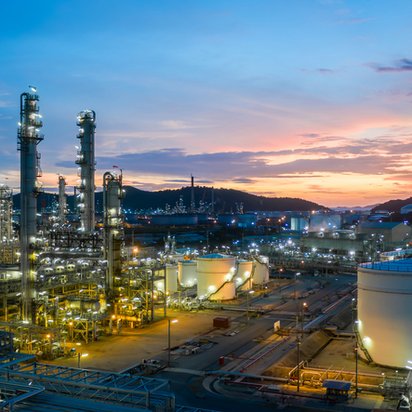
The design and operation of outdoor facilities place particular demands on fire safety. As traditional building regulations are primarily designed for buildings, individual, scenario-based fire safety risk assessments must be carried out for these special structures (generally unregulated special structures) (scenario-based fire safety).

The construction of new facilities or the modification of existing ones generally requires a permit under the Control of Emissions Act. The application for a permit under the Control of Emissions Act (BImSchG application) required for authorisation usually also includes, depending on the project, an application for planning permission (building application). Depending on the project, a fire safety certificate – usually a so-called fire safety concept – must be submitted alongside the planning application documents.
As both building regulations and hazardous substances legislation often lack specific fire safety requirements for open-air process facilities, the focus is on the general formulation of protection objectives: to protect life, to prevent the outbreak and spread of fires, and to enable fire-fighting measures. Our safety philosophy regarding fire safety risk assessments is based on a clear hierarchy:
It should be borne in mind that conventional building regulations are based on the standard temperature-time curve (ETK). Under the ETK, temperatures of 1,000 °C or higher are only reached after a fire duration of approximately 90 minutes. In open-air process plants, hydrocarbons are generally handled, meaning that the hydrocarbon fire curve (HC fire curve) must be used. With the HC fire curve, temperatures of 1,000 °C or more are reached after a fire duration of less than 10 minutes.
In addition to process plants, tank farms (fixed tanks), hazardous substances storage facilities (storage of portable containers) and their filling and emptying points are frequently part of the process infrastructure. Here too, we support you with our fire safety expertise, taking into account not only building regulations but also the fire safety requirements of hazardous substances legislation. Of particular relevance here are the following sets of regulations under hazardous substances legislation, as well as other Technical Rules for Hazardous Substances, guidelines and standards:
Sales Team
+49 231 5333-430
IND7-VID@dmt-group.com
Fire safety consultancy can be provided as early as the preliminary and conceptual design stages, so that fire safety requirements can be taken into account as early as possible in the planning process. An initial assessment is carried out of the fire safety measures required under building regulations and legislation governing hazardous substances.
Taking into account fire safety requirements under building regulations and legislation on hazardous substances, we prepare fire safety assessments, fire safety concepts, fire safety reports, preliminary fire safety concepts, etc.
We assist in reconciling the requirements set out in the fire safety documentation (usually the fire safety concept) and the planning permission with the results of the detailed design, in order to avoid unnecessary iterative design stages.
We check that the necessary fire safety equipment has been installed correctly and that relevant regulations are being complied with, in order to avoid costly retrofitting work at a later stage.
Our fire safety officers carry out regular on-site inspections to check that fire safety requirements are being met during day-to-day operations and to advise the operator on their implementation.
Working closely with our sister company within the group, TÜV NORD EnSys, we provide support in the assessment of existing passive fire protection measures (e.g. fire-resistant insulation on columns and beams of process scaffolding), where the relevant documentation is lacking, in order to avoid costly new installations.
Evacuation and emergency plans in accordance with ASR A2.3 and DIN ISO 23601
; fire service plans in accordance with DIN 14095
; fire safety regulations
Working closely with our sister company, TÜV NORD System, you can have fire safety tests carried out on building components and materials.
Working in close collaboration with our sister company, TÜV NORD System, we provide inspection services for technical systems and installations (e.g. fire-extinguishing systems, fire-alarm systems, ventilation systems, smoke extraction systems and electrical installations).
As traditional building regulations are primarily designed for buildings, outdoor facilities (e.g. in the chemical, refining or pharmaceutical industries) are regarded as unregulated special structures. No standard framework applies here, which is why individual, scenario-based risk assessments are absolutely essential.
The construction or modification of outdoor process facilities usually requires a permit under the Federal Immission Control Act (BImSchG). The BImSchG application required for this usually also includes the application under building regulations (building application), for which a professional fire safety assessment or a so-called fire safety concept must be submitted.
In the absence of specific regulations, the focus is on the general formulation of protection objectives and the derivation of fire safety measures from these on a case-by-case basis.
Our safety philosophy is based on a clear set of priorities:
Standard temperature-time curve (ETK): Standard under conventional building regulations; temperatures of 1,000 °C or higher are only reached after approximately 90 minutes of fire duration.
Hydrocarbon fire curve (HC fire curve): Depending on the substances handled, a benchmark for process engineering plants; temperatures of 1,000 °C or more are reached in less than 10 minutes of burning time, as hydrocarbons have a significantly higher energy density than fires involving cellulosic materials.