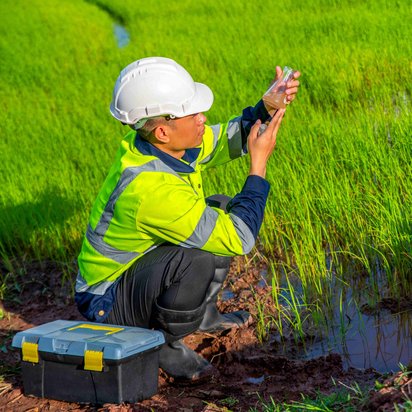
Hydrogeochemistry studies the chemical composition of water and the interactions between water, rock, soil and man-made structures. It provides the basis for the assessment of groundwater, mine water and surface waters, and supports the sustainable protection of water bodies and groundwater.
The chemical composition of a body of water is largely determined by its natural and man-made environment. Water from urban areas, industrial estates, near-natural landscapes or mines often exhibits different hydrogeochemical properties. We analyse these waters, assess their quality and investigate changes over time.
Water analysis provides clarity on current water quality and potential sources of contamination. Through regular monitoring, we identify changes at an early stage and lay the foundations for sound decision-making in infrastructure, industrial and mining projects.
Our experts assess hydrogeochemical processes such as dissolution and precipitation reactions, identify sources of contamination and analyse their spatial distribution. With the aid of modern geochemical modelling and three-dimensional visualisations, complex relationships can be presented in a clear and comprehensible manner, and future developments can be reliably predicted.
Hydrogeochemical investigations provide important insights into:
Particularly in mining and industrialised regions, water quality and contaminant loads often change over extended periods. Furthermore, climate change is increasingly affecting the availability and quality of water resources. Continuous hydrogeochemical assessment helps to identify risks at an early stage, meet regulatory requirements and ensure the sustainable use of water resources.

Debora Reinke
Head of Hydrogeology & Water Management
I look forward to hearing from you regarding hydrogeochemistry!
+49 201 172-1876
DMT offers services to protect groundwater bodies used for drinking water supply.
Our parent company, TÜV NORD GROUP, offers a full range of services for qualified sampling in accordance with the Drinking Water Ordinance (TrinkwV), as well as the corresponding microbiological, chemical and physical analyses.
Please feel free to contact our experts with any questions you may have regarding the Drinking Water Ordinance (TrinkwV).
In our laboratory, we carry out simple dissolution and leaching tests which can be used to calibrate hydrogeochemical models. DMT does not operate an accredited laboratory for hydrogeochemical analyses.
Water quality is a key factor in the use, protection and management of water resources. Hydrogeochemical studies provide the basis for assessing risks, taking environmental concerns into account and complying with legal requirements.
Typical applications include, for example, construction and infrastructure projects, where knowledge of the groundwater’s corrosiveness towards concrete and steel is required to ensure the structural stability of the building. Furthermore, water analyses are required for dewatering operations, environmental monitoring, contaminated site investigations and mining-related issues.
By combining sampling, laboratory analysis and expert assessment, it is possible to identify contamination and narrow down potential sources of pollutants. This enables the causes to be determined and appropriate countermeasures to be developed.
Hydrogeochemical investigations provide important evidence for proceedings under water and environmental law. The results assist authorities, project developers and planners in assessing potential impacts on water bodies and water resources.