Soil Management
Bodenmanagement für Bau- und Infrastrukturprojekte
Request advice on soil management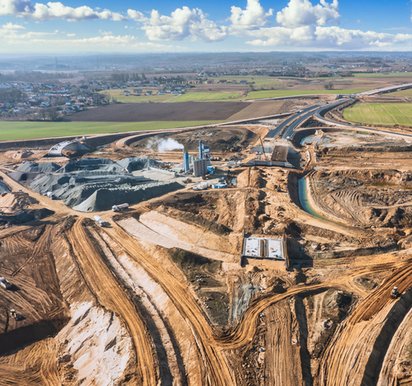
Bodenmanagement für Bau- und Infrastrukturprojekte
Request advice on soil managementProfessional soil management lays the foundations for cost-effective, sustainable and legally compliant construction and infrastructure projects. It encompasses the analysis, assessment, recovery and disposal of soil material throughout the entire project cycle. DMT supports clients with its interdisciplinary engineering expertise in managing material flows transparently, utilising resources efficiently and reliably meeting regulatory requirements.
Declaration of soil and excavated material
under waste legislation We assess soil materials in accordance with the requirements of the Framework Ordinance and the Ordinance on Substitute Building Materials (EBV). Based on reliable analyses, we draw up legally compliant declarations and lay the foundations for safe recovery or disposal.
Mass balances and cost-effective recovery concepts
A robust mass balance is crucial for managing material flows. We draw up project-specific mass balances and develop economically optimised recovery and disposal concepts. This enables transport distances to be reduced, resources to be conserved and project costs to be managed effectively.
Chemical analyses and material flow assessments
The assessment of soil quality is based on thorough chemical analyses and a holistic material flow analysis. We evaluate the suitability of the material for recovery, identify appropriate recovery pathways and highlight potential for optimising logistics, sustainability and cost-effectiveness.
Interdisciplinary project management
Soil management requires the integration of various specialist disciplines. Our experts in geotechnical engineering, hydrogeology, surveying and environmental consultancy work closely together to provide solutions from a single source. In this way, we ensure transparent, traceable and legally compliant project management.
The quality and suitability of the soil material supplied have an impact on a project’s safety, costs and schedule. With clearly defined testing and approval processes, we support clients in managing their material flows in compliance with the law.
We check the origin and documentation of the delivered material and assess its suitability for the intended use.
We assess existing analyses and declarations for completeness, plausibility and compliance with legal requirements.
Our experts assess whether the installation is permissible, taking into account current environmental and waste management regulations.
Structured approval procedures ensure transparency, quality assurance and comprehensive documentation of material flows.
Through transparent processes, we minimise project, liability and approval risks and ensure planning certainty for all parties involved.
Our experts work with you to develop cost-effective, sustainable and legally compliant solutions for the management of soil and excavated material.
Soil management encompasses the analysis, assessment, reuse and disposal of soil material during a construction or infrastructure project. The aim is to manage all material flows in a manner that complies with the law, is cost-effective and sustainable.
The declaration serves to classify the material in accordance with the legal requirements of the Mantelverordnung and the Ersatzbaustoffverordnung. It forms the basis for recovery, reuse or disposal.
Mass balances provide transparency regarding the quantities of materials generated and enable the early planning of recycling and disposal routes. This helps to reduce costs, transport and project risks.
The assessment is based on chemical analyses, soil surveys and project-specific requirements. Suitable recovery or disposal options are then determined on this basis.
The most important sets of regulations include the Framework Ordinance, the Alternative Building Materials Ordinance (EBV), the Circular Economy Act (KrWG) and additional state-specific requirements for the recovery and disposal of soil.