Planning of mine access points (Mine Access Design)
Shaft construction and shaft design with DMT
Request advice on shaft construction and planning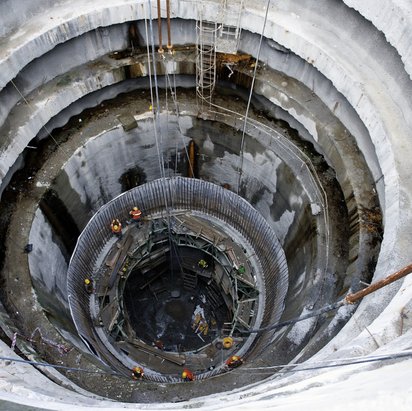
Shaft construction and shaft design with DMT
Request advice on shaft construction and planningThese include shafts, tunnels, ramps and temporary underground structures, which ensure safe, economical and sustainable access to the deposit and to the individual mining areas.
The design of mine access points has a decisive influence on investment costs, construction time, operational safety, production capacity and the long-term economic viability of a mine. Even in the early stages of a project, the location, geometry and support concepts determine the technical and economic performance of the entire mine infrastructure.
DMT develops holistic concepts for mine development, integrating geology, geotechnics, hydrogeology, ventilation, surveying, monitoring, and structural and civil engineering design into a unified planning approach. Through this interdisciplinary collaboration, we establish a basis for decision-making, reduce project risks and optimise technical feasibility throughout the entire life cycle of a mine.
Our services range from concept studies and feasibility studies, through basic and detailed planning, to technical support during construction. During construction, we support clients with technical consultancy, planning reviews, verification of planning assumptions and engineering services throughout the construction process. The continuous assessment of actual rock and groundwater conditions enables targeted adjustments to the planning and helps to enhance safety, efficiency and cost-effectiveness.
Dr Lucy Schlicht
Natural Resources/Geomechanics
+49 201 172 1967
A reliable data set is essential for successful mine development. We develop bespoke investigation programmes and undertake the planning and execution of in-situ investigations, drilling programmes and laboratory analyses.
Based on the data obtained, we produce geotechnical and hydrogeological models, as well as factual and interpretative reports on ground conditions, rock conditions and groundwater conditions. Our experts use this information to derive the necessary parameters and recommendations for further planning.
Site investigation for mineral resources using seismic methods is a key exploration technique at DMT.
In addition to seismic methods, DMT also offers geological exploration and modelling services.
Geotechnical design forms the basis for the safe and cost-effective construction of shafts, tunnels and ramps.
For tunnels and ramps, we develop technically optimised alignments and tailor the geometry, excavation methods, support concepts, drainage and ventilation to the respective geological and operational constraints.
The aim is to achieve a solution that is safe in the long term, cost-effective and easy to implement, and which integrates seamlessly into the mine’s overall concept.
An efficient ventilation system is a key prerequisite for safety and efficiency in underground mining.
We develop ventilation concepts for shafts, tunnels and ramps, and design air flow rates, ventilation routes and ventilation networks for all construction and operational phases. In doing so, we take into account both the requirements during sinking and tunnelling and the long-term requirements of subsequent mine operations.
The result is safe and energy-efficient ventilation systems with high operational availability.
Hydrogeological constraints have a significant influence on the technical feasibility and economic viability of shaft and tunnel projects.
DMT investigates groundwater conditions, assesses potential water ingress and identifies hydrogeological risks as early as the initial project phases. Building on this, we develop concepts for dewatering and groundwater control.
By incorporating hydrogeological considerations at an early stage, we minimise construction risks and lay the foundations for safe and reliable operation.
Precise geospatial data forms the basis for the planning, construction and operation of underground infrastructure.
DMT utilises modern geographic information systems (GIS), high-precision surveying technologies and digital data analysis methods to provide efficient support for planning and construction processes.
Bringing together surveying, geological and geophysical data within a single data environment provides a sound basis for route planning, construction supervision and risk management.
Continuous monitoring ensures transparency and supports safe project management during construction and operation.
DMT Geomonitoring operates independently of specific methods and integrates data from geotechnical engineering, geodesy, geophysics, as well as vibration and noise measurements. Using modern measurement techniques such as GNSS, total stations, radar interferometry, laser scanning and geotechnical sensors, we record changes in real time.
Via the DMT SAFEGUARD digital platform, measurement data is automatically analysed, visualised and, where required, linked to alarm and early-warning functions.
This enables potential risks to be identified at an early stage and appropriate measures to be taken in good time. This enhances safety, improves the basis for planning and supports efficient project delivery.
DMT develops bespoke safety concepts for fire and explosion protection, emergency response and occupational health and safety for all types of underground infrastructure.
Please get in touch with our team of fire and explosion protection experts.
Mine Access Design involves the planning and optimisation of all underground access routes within a mine, including shafts, tunnels, ramps and temporary underground structures.
Key factors include geology, geotechnical conditions, groundwater conditions, ventilation, logistics, safety requirements, investment costs and operational requirements.
As early as the concept and feasibility phase, as decisions taken at this stage have a significant impact on costs, construction time and cost-effectiveness.
Hydrogeological investigations help to assess water inflows, minimise risks and develop suitable strategies for drainage and groundwater control.
Monitoring enables the continuous surveillance of structures, rock masses and the surrounding environment. Changes are detected at an early stage, so that countermeasures can be taken in good time.