Stability of Slopes
Slope stability for safe earthworks and earthworks operations
Request advice on slope stability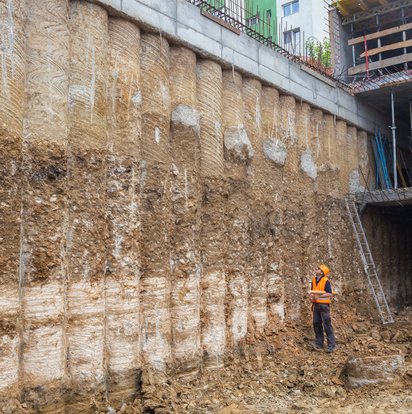
Slope stability for safe earthworks and earthworks operations
Request advice on slope stabilityThe stability of slopes is a key prerequisite for safe and cost-effective earthworks and earth-moving operations. It ensures the long-term stability of slopes, cuttings and excavation pits, and minimises risks to people, infrastructure and adjacent structures.
DMT supports clients with geotechnical expertise in the planning, assessment and implementation of suitable stabilisation measures. Based on detailed ground investigations, we develop project-specific solutions that combine safety, efficiency and cost-effectiveness.
Shotcrete reinforcement stabilises embankments and excavation surfaces either temporarily or permanently. It protects against erosion and soil displacement and is often combined with other stabilisation measures.
In soil nailing, steel nails are driven into the ground to increase the internal stability of the slope. This method is particularly suitable for steep slopes and urban construction projects.
Beam-and-sheet pile walls offer a cost-effective solution for temporary excavation shoring. This involves driving steel beams into the ground and supplementing them with sheet piles or infill panels.
Sheet piling is used to stabilise excavation pits and embankments, as well as to protect against water ingress. It is used in particular in water-bearing soils and in harbour, water and infrastructure construction.
Bored pile walls enable the construction of permanently load-bearing and low-deformation excavation shoring systems. They are particularly suitable for challenging inner-city and infrastructure construction projects.
Diaphragm walls offer high load-bearing capacity and watertightness. They are used in particular for deep excavation pits, tunnel structures and complex infrastructure projects.
Retaining walls reduce or prevent groundwater flow and play a vital role in protecting structures and the environment.
In the jet grouting process, the existing soil is broken up using high-pressure jets whilst simultaneously being consolidated. This results in load-bearing and water-impermeable ground improvements.
Complex ground conditions often require a combination of different methods. DMT develops bespoke solutions based on geotechnical analyses, numerical calculations and many years of experience.

Dr Roland Weißmann
Head of Geotechnical Engineering
+49 201 172 1643
The stability of slopes refers to the ability of a slope or an excavation wall to remain stable over the long term and not to develop any unacceptable deformations or slippage.
Slope stabilisation is required when soil conditions, slope gradients, groundwater or structural effects compromise the natural stability of the slope.
The most common methods include ground nailing, shotcrete reinforcement, beam-and-pile walls, sheet pile walls, bored pile walls, slotted walls and jet grouting.
Stability is verified by means of geotechnical investigations, soil analyses, calculations and numerical models in accordance with the applicable standards and guidelines.
Groundwater affects the bearing capacity and stability of the ground. It is therefore essential to take water pressures and potential water ingress into account when planning and securing embankments and excavation pits.