Skip to content

Designing fire safety measures for lithium batteries to ensure they are safe and proportionate to the risks

We develop bespoke fire safety concepts for lithium batteries in energy storage systems, logistics, recycling and charging infrastructure, taking into account specific risks such as thermal runaway, fire spread and incident management.

Lithium batteries have become indispensable in modern applications. They are driving the transport revolution, securing our energy supply and are an integral part of our everyday lives. Whether in smartphones, laptops, power tools or stationary energy storage systems – high-performance lithium batteries with high energy density are used everywhere.

However, as power density increases and volumes rise, so too does the potential for fire and other hazards. Specialised fire safety measures are required, particularly when dealing with large quantities of batteries, high charging rates or used batteries.

Typical areas of application for lithium batteries with an increased risk potential include, amongst others:

  • The automotive industry, workshops and charging infrastructure
  • Stationary battery storage systems (e.g. in conjunction with renewable energy sources)
  • Logistics centres and transhipment hubs
  • Recycling, waste disposal and materials recovery facilities
Contact

“Effective fire safety measures for lithium batteries not only protect people and facilities, but also ensure operational availability, safeguard investments and maintain insurability.”

Please contact our fire safety experts with your enquiry.

Sales Team
+49 231 5333-430
IND7-VID@dmt-group.com

Specific fire behaviour of lithium batteries

In the event of a fire, lithium batteries can undergo what is known as ‘thermal runaway’. During this process, the electrical energy stored in the battery cell is converted into heat within a short space of time.

The heat released can thermally activate neighbouring cells, causing them to go into thermal runaway as well. This chain reaction (‘propagation’) can lead to the combustion of entire modules or battery systems – often accompanied by:

  • very high temperatures
  • rapid fire spread
  • toxic and flammable smoke and venting gases

Due to this characteristic fire behaviour, lithium batteries place special demands on prevention, detection, fire-extinguishing techniques and incident management.

Typical fields of application

Stationary battery storage systems are used to store and supply electrical energy as and when required – for example, to stabilise the grid, cover peak loads or provide temporary storage for renewable energy (wind, solar).

Characteristic features include:

  • several battery systems with very high power output in a compact space,
  • in some cases, the use of second-life batteries,
  • installation without the need for permanent staff presence.

The protection objective here is generally to safeguard property and – depending on usage – to ensure system availability. Mechanical or thermal stresses rarely occur during normal operation; instead, the risk assessment focuses on the electrical stresses caused by charging and discharging processes.


In logistics centres and transhipment points, lithium batteries of a wide variety of designs and power ratings are stored and handled.

Distinctions are made, amongst other things, according to:

  • Type of storage (block, racking, manual or automated)
  • Type of goods stored (cells, modules, battery systems, batteries in devices)
  • Size, capacity and packaging of the batteries

Storage as a hazardous substance is generally excluded under TRGS 510. Nevertheless, there are significant fire risks that are relevant both under building regulations and from the perspective of the insurance industry.

Protection concepts are therefore developed on a risk-based basis and typically include:

  • structural partitions and the creation of storage zones
  • early detection of critical incidents
  • appropriate fire-extinguishing techniques
  • Contingency and emergency plans for faulty batteries

Issues such as smoke and gas extraction, as well as explosion protection, may also play a role.
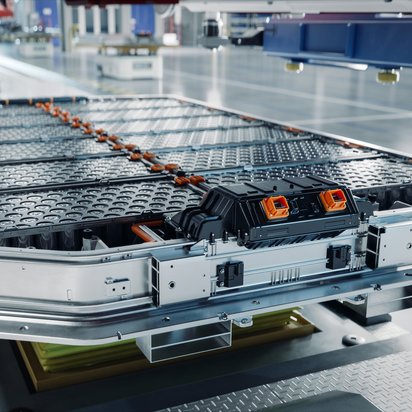
In the waste management and recycling sector, the potential for risk is particularly high. This often involves:

  • batteries at the end of their life cycle
  • damaged or seriously faulty batteries
  • batteries disposed of incorrectly (incorrectly sorted waste)

Mechanical stresses in sorting, shredding and processing plants can lead to uncontrolled thermal runaway. At the same time, large volumes of waste represent a significant fire load.

Effective protection strategies aim to:

  • detect and remove incorrectly disposed-of batteries at an early stage
  • to detect and extinguish batteries that have passed through the system quickly
  • to contain fire incidents locally and safely isolate the affected waste

  • Transport facilities and charging infrastructure
  • Storage facilities for small battery-powered appliances
  • Sales, workshop and storage areas for e-bikes and e-scooters
  • Car dealerships and garages

Our fire safety services for power stations (in accordance with the service phases of the HOAI)

Fire safety consultancy can be provided as early as the preliminary and conceptual design stages, so that fire safety requirements can be taken into account as early as possible in the planning process. An initial assessment is carried out of the fire safety measures required under building regulations and legislation governing hazardous substances.

Taking into account fire safety requirements under building regulations and legislation on hazardous substances, we draw up fire safety certificates, fire safety concepts, fire safety reports, preliminary fire safety concepts, etc.

We assist in reconciling the requirements set out in the fire safety documentation (usually the fire safety concept) and the planning permission with the results of the detailed design, in order to avoid unnecessary iterative design stages.

We check that the necessary fire safety equipment has been installed correctly and that relevant regulations are being complied with, in order to avoid costly retrofitting work at a later stage.

Our fire safety officers carry out regular on-site inspections to check that fire safety requirements are being met during day-to-day operations and to advise the operator on their implementation.

Evacuation and rescue plans in accordance with ASR A2.3 and DIN ISO 23601
; fire service plans in accordance with DIN 14095
; fire safety regulations in accordance with DIN 14096

To assist with the removal of damaged batteries from your warehouse, we can help draw up contingency plans

In close collaboration with our sister company, TÜV NORD System, fire safety measures can be tested in practice through specialised fire tests. Fire tests of up to 30 MW can be carried out in an underground fire tunnel equipped with a flue gas cleaning system. In addition to standardised tests (nail penetration tests, abuse tests), we also carry out bespoke testing services. Your bespoke fire safety concept can therefore be validated in real-scale fire tests. Include a link to the relevant website

In addition to purely fire safety considerations, we check your building project for compliance with the WHG and the AwSV

Working closely with our sister company, TÜV NORD System, we provide inspection services for technical systems and installations (e.g. fire-extinguishing systems, fire-alarm systems, ventilation systems, smoke extraction systems and electrical installations). Include a link to the relevant website

Our references: A selection of clients in the field of fire safety for the handling of lithium batteries

  • ABO Energy
  • EnBW
  • Esco
  • Maersk
  • Duisburg Municipal Utilities
  • Statkraft
  • Trimet
  • Vivawest
  • Uniper

Contact us

Please get in touch with our fire safety experts and let us know what you need. We look forward to hearing from you!

Things you should know

Frequently asked questions about fire safety relating to lithium batteries

Lithium batteries are characterised by their very high energy density. They enable large amounts of energy to be stored whilst being lightweight and compact. This makes them indispensable for applications in the mobility sector (e.g. electric vehicles, e-bikes, e-scooters), in stationary energy storage systems, and in everyday devices such as smartphones, laptops and battery-powered tools.
However, this high energy density carries an increased risk of fire, particularly in the event of malfunction or damage.

Lithium batteries contain, amongst other things, flammable electrolytes. Overheating, mechanical damage or a short circuit can lead to thermal runaway. This causes a large amount of energy to be released in a short space of time, which can result in high-intensity fires.

Lithium batteries can pose the following risks, amongst others:

  • Risk of fire and explosion due to thermal runaway
  • Release of toxic and flammable smoke and venting gases
  • Electrical hazards (e.g. electric shock)
  • Environmental hazards in the event of improper storage or disposal

Thermal runaway is the uncontrolled thermal decomposition of a battery cell, during which large amounts of energy are released in the form of heat.
This often results in so-called venting gases escaping under high pressure, which can ignite and cause flash fires.
Thermal runaway in a single cell is generally unstoppable – the aim of protective and extinguishing measures is therefore to limit its spread to neighbouring cells.

Propagation describes the spread of thermal penetration to neighbouring cells or modules, triggered by the effects of heat.
The primary aim of all fire safety measures is to prevent or halt this propagation, for example through:

  • effective cooling (e.g. extinguishing or cooling water),
  • preventing the ignition of venting gases (e.g. using fire-suppression gases),
  • limiting secondary fires.

Yes. The level of risk is influenced, amongst other things, by:

  • State of Charge (SoC) – the higher the SoC, the greater the potential energy release,
  • cell chemistry and design,
  • the battery’s stage in its life cycle.

In GGR 024, the BAM distinguishes between different cell chemistries. In future, a classification based on propagation behaviour is planned.
In addition, a distinction is often made between:

  • new batteries,
  • used batteries,
  • batteries at the end of their life cycle,
  • (critically) defective batteries.

Under transport law, classification is based on UN numbers (e.g. UN 3480, UN 3481, UN 3536).

In principle, yes – provided they are undamaged and have retained their performance. Used batteries must be checked regularly.
Deeply discharged or damaged batteries should not be used any further, as there is a significantly increased risk of thermal runaway in such cases.

Yes. Second-life batteries may suffer from material fatigue or hidden damage. Before use, they must undergo professional testing, and appropriate fire safety measures must be put in place.

There are no standardised legal regulations governing lithium batteries. The requirements depend on the application and are derived from building regulations, occupational health and safety, hazardous substances, dangerous goods, environmental and insurance regulations, in particular the BVES guidelines, VdS 3103, TRGS 510, the ADR/RID transport regulations, IATA-DGR and the IMDG Code, as well as the Battery Act and the EU Battery Regulation (EU 2023/1542).
Fire safety plans are therefore developed on a risk-based and site-specific basis. 

In the event of lithium battery fires, water is generally the most suitable extinguishing agent, as its high cooling effect prevents the thermal runaway from spreading to neighbouring cells and extinguishes secondary fires.
Other extinguishing agents, such as fire-suppressing gases or aerosols, may provide additional support in specific cases, but they do not replace the necessary cooling and must be assessed on a case-by-case basis.

Lithium batteries must only be charged using chargers approved by the manufacturer. During charging, ensure there is adequate ventilation, that the permissible ambient temperature is maintained, and that there is no unusual heating.
Faulty chargers, damaged batteries or missing safety features can lead to overcharging, overheating and thermal runaway, and pose a significant fire risk. 

Lithium batteries must never be disposed of with household waste. Faulty or damaged batteries must be stored separately, in a fireproof container where possible, and handed in exclusively at authorised collection points or recycling centres.
Improper disposal can lead to fires, explosions and environmental hazards.

When used as intended, lithium batteries are considered safe.
However, if used incorrectly or if they are faulty, flammable gas mixtures may be produced which could create an explosive atmosphere.

Whether fire-fighting water retention is required depends on the use of the premises, the federal state and the fire-fighting concept.
According to the AwSV, contaminated fire-fighting, sprinkler or cooling water must, as a general rule, be retained. The relevant guidelines include the Fire-Extinguishing Water Retention Guideline, VdS 2557 and the VCI guidelines.
For gas fire-extinguishing systems using oxygen displacement, fire-extinguishing water retention is not usually required.

Classification is carried out, depending on the context, for example, according to:

  • Dangerous goods regulations (ADR, UN numbers)
  • Insurance guidelines (e.g. VdS)
  • chemical composition and design

At present, there are no uniform statutory regulations at federal level that comprehensively govern fire safety in relation to the handling of lithium batteries under building regulations. Requirements regarding the installation of battery systems and energy storage systems may arise from the electrical building regulations of the individual federal states.

In addition to building regulations and legislation on dangerous goods, factors such as insurance regulations, technical standards, manufacturers’ specifications and recognised rules of good engineering may also be relevant.

Fire behaviour is influenced in particular by

  • cell chemistry and design
  • State of charge (SoC)
  • Battery quality and existing protective mechanisms
  • Age, usage history and pre-existing damage