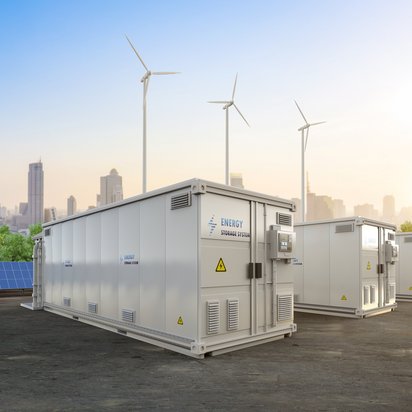
Battery storage systems are increasingly becoming a tool for active energy management. They make it possible to tailor electricity procurement and self-generation specifically to price trends, production requirements and grid restrictions. DMT is actively shaping this development by planning and implementing storage projects.
Enquire about a battery storage project now
In future, security of supply will not be determined solely by guaranteed generation capacity. Equally important is the energy system’s ability to respond flexibly to short-term changes.
Battery storage systems enable precisely this responsiveness. They can provide power reserves within a very short time and support local supply concepts. This creates additional security and operational reserves for energy-intensive industrial plants, data centres, transport infrastructure and hydrogen production sites.
In combination with smart control and forecasting systems, battery storage helps to monitor energy flows transparently and optimise them for the benefit of the system.

The more renewable energy, hydrogen technologies and decentralised generation structures are expanded, the more important it becomes to be able to balance energy flows in real time. Battery storage increases the storage capacity of an energy system and improves its adaptability. This makes a concrete contribution to decarbonisation, security of supply and the efficient use of existing infrastructure.
DMT supports the development of an energy system based on flexibility, digitalisation and sustainable value creation through:

Dr. Stefan Rabe
Managing Consultant
DMT ENERGY ENGINEERS
+49 171 770 7706
In the debate on future energy systems, battery storage and hydrogen are often considered in isolation. In fact, both technologies fulfil different roles within the same value chain. Battery storage is particularly well suited to time scales ranging from seconds to several hours. Hydrogen offers advantages when energy needs to be stored over days, weeks or months.
Combining both technologies creates a flexible overall system:
This gives rise to cross-sector energy systems that link electricity, industry, mobility and heating.
The transition to a decentralised energy system, based largely on renewable energy sources, requires in-depth knowledge, collaboration and robust technical solutions. DMT supports this development with interdisciplinary expertise in energy engineering, infrastructure planning, risk assessment, digitalisation and regulatory compliance.