Skip to content

Creating integrated solutions for industry, energy and mobility using hydrogen

Modern industrial and commercial sites are increasingly evolving into integrated energy systems. Hydrogen enables sector coupling between electricity supply, heat supply, industrial production and mobility.

Designing modern infrastructure. Get in touch now and get your project started.
Person mit Schutzhelm und gelber Warnweste, die auf einem Industriegelände steht. Die Person hält ein Funkgerät und einen Laptop in den Händen und blickt zur Seite. Im Hintergrund sind unscharf große Hafenkräne und Container zu sehen
From hydrogen hubs to regional centres of value creation

Shaping sector coupling between electricity supply, heat supply, industrial production and mobility through hydrogen

Modern industrial and commercial sites are increasingly evolving into integrated energy systems. Hydrogen enables sector coupling between electricity supply, heat provision, industrial production and mobility. Renewable electricity from wind or solar power plants can be converted into hydrogen via electrolysis and stored. The hydrogen produced can then be used for industrial processes, to power vehicle fleets or to be reconverted into electricity. This creates flexible and resilient supply systems that balance out fluctuations in renewable energy and enhance security of supply. 

This is because industrial estates and industrial clusters are characterised by high and often continuous energy demand. In addition to electricity, many companies also require process heat, steam or chemical energy carriers for their production processes. These requirements cannot always be met by renewable electricity alone, and traditional electrification concepts frequently come up against technical, infrastructural or economic limitations in this regard.

Sectors such as the steel, chemical, glass, cement, paper and refining industries, in particular, can make significant contributions to achieving their climate targets through the use of hydrogen. Furthermore, the shared use of generation, transport and storage infrastructure improves cost-effectiveness and creates the conditions for an efficient ramp-up of the hydrogen economy.

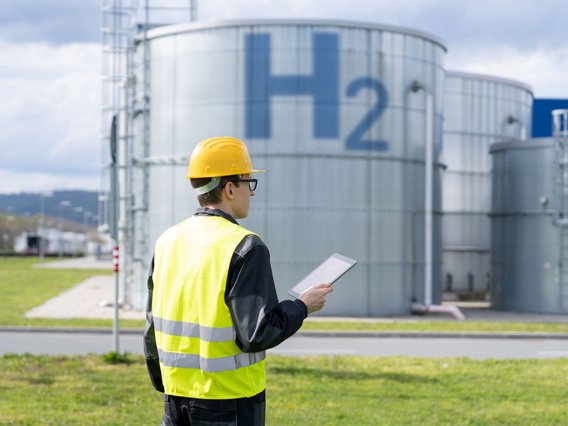
 Person mit gelbem Schutzhelm und gelber Warnweste, die auf einem Industriegelände steht. und auf Wasserstofftanks blickt.

A well-founded integration of demand and infrastructure

With DMT by your side, you’ll benefit from comprehensive expertise in the planning, implementation and optimisation of your hydrogen projects. An overview of our services:

  • Technology comparison: We analyse various hydrogen technologies to find the best solution for your project.
  • Cost analysis: Work with us to determine the projected hydrogen production costs so you can plan your investment effectively.
  • Plant size: We help you determine the ideal size for your electrolysis plant to maximise efficiency and cost-effectiveness.
  • Site assessment: Our experts evaluate all relevant site factors, including the availability of renewable energy, the infrastructure for hydrogen transport and distribution, and the regulatory framework.
  • Permit management: We handle the regulatory framework and the application for permits, so you can focus on your core business.
  • Grant advice: We research and identify suitable funding schemes and support you throughout the application process, ensuring your project gets off to a smooth start. 

Find out more about our H2. Parks consultancy services in our leaflet. 

Jan Simoneit, Consultant Hydrogen

"Hydrogen offers the opportunity to combine decarbonisation, security of supply and competitiveness. This paves the way for cross-sector applications through sustainable energy concepts that deliver long-term added value."

Jan Simoneit
, Consultant, Hydrogen Competence Centre


DMT ENERGY ENGINEERS
+49 160 6399805

Send an email to Jan Simoneit.
Hydrogen as a building block of a sustainable industry

DMT expertise in integrated energy systems

Industrial clusters can develop into regional hydrogen hubs. This creates an ecosystem comprising producers, consumers, infrastructure operators, research institutions and technology providers.

The benefits are manifold:

  • Greater security of supply
  • Regional value creation
  • Strengthened competitiveness
  • Attractiveness to investment
  • Creation of new jobs
  • Acceleration of decarbonisation

Such sites can also fulfil important functions within a future European hydrogen network and serve as hubs for the production, storage, distribution and use of hydrogen.

As part of the TÜV NORD GROUP, DMT combines more than 280 years of engineering experience with digitalisation, interdisciplinary expertise and international project competence. Our experts develop holistic solutions that take equal account of technical feasibility, economic viability and regulatory requirements.