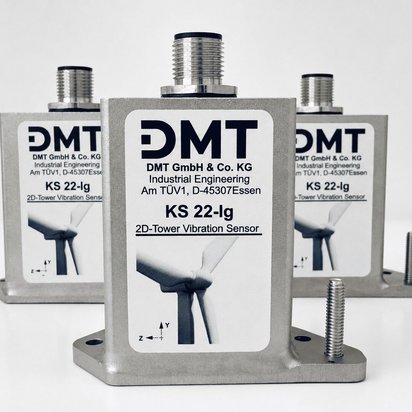
Wind turbines are subjected to high stresses such as oscillations and vibrations. To prevent damage and costly downtime, vibrations must be reliably monitored. Guidelines such as GL2010 also require tower vibration monitoring.
Furthermore, accurate information on the vibrations actually occurring – whilst taking natural frequency requirements into account during the design phase – provides a sound basis for optimising calculation methods for tower construction.
DMT’s compact KS22-U and KS22-I sensors measure tower vibrations in two dimensions, with a measurement range of ± 5 g. Measurement values are transmitted to the plant control system as a 5 ± 3 V or 4…20 mA signal, enabling the plant to be shut down safely should the specified limit values be exceeded.
Robust and reliable sensor technology is particularly important for vibration meters, especially in harsh environmental conditions.
DMT’s tower vibration sensors offer the necessary features: a robust housing, a high IP66 protection rating and a wide temperature range from -40°C to +65°C.
We supply our tower vibration sensors as standard products and also in customised versions.
When integrated into the plant control system, the KS22-I / KS22-U reports:
Data acquisition:
The measurement data that has been recorded and stored can also be used to assess the load history of wind turbines. This enables more accurate conclusions to be drawn regarding their overall service life.
Furthermore, unlike estimates, the service life forecast for expert reports is based on actual fatigue loads. This makes the forecast more accurate, resulting in lower safety margins (end of warranty / continued operation).
Please do get in touch if you would like to implement specific projects, including the monitoring of tower vibrations or the use of vibration meters.

Your contact:
Michael Schneider
+49 160 8884392