Skip to content

Tunnel ventilation for safe and efficient construction projects

DMT develops bespoke solutions for tunnel ventilation, air circulation and monitoring in tunnels, mines, sewerage systems and landfill sites.

Request a consultation on tunnel ventilation
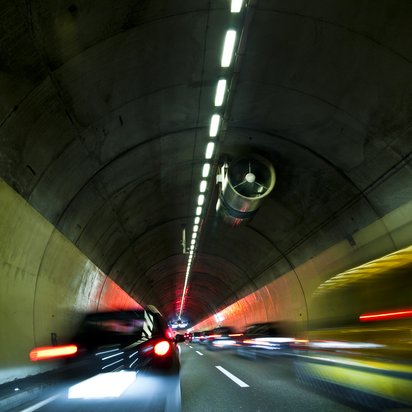
Straßentunnel mit Turbinenlüftung

DMT designs and monitors ventilation systems for tunnels, mines, and infrastructure projects.

Our services include ventilation and dust control solutions, the measurement of pollutant concentrations, digital monitoring using DMT SAFEGUARD, and consultancy on safety-related requirements. In this way, we ensure optimum air quality and efficient project workflows, and develop concepts for the control of gases, dust and emissions, as well as for a needs-based air supply on construction sites and in industrial facilities.

We take safety-related, technical and economic requirements into account right from the start. The result is ventilation concepts that reduce risks, make efficient use of resources and support the smooth running of your project.


Consulting on Tunnel Ventilation

Please get in touch with our team of tunnel ventilation experts; we look forward to hearing from you.

Dipl.-Ing. Thomas Geldmacher
Head of Tunnel Ventilation
+49 160 888 5220

Ventilation Systems for Tunnels, Mines, and Infrastructure

Reliable tunnel ventilation ensures the required air quality during tunnel excavation, maintenance work and ongoing operations. DMT supports operators, construction companies and manufacturers of tunnelling machinery and monitoring technology worldwide in the planning and implementation of suitable ventilation and monitoring concepts.

We calculate the required air flow rates, select suitable fans and measurement equipment, and develop concepts for monitoring the air supply and potential releases of pollutants. In doing so, we take into account occupational health and safety requirements, project-specific constraints and the protection of staff.

Our Tunnel Ventilation Services

  • Ventilation concepts for tunnel excavation
  • Ventilation concepts for construction work in railway and road tunnels
  • Design of stationary and mobile ventilation systems
  • Design and sizing of specialised ventilation systems
  • Determination of air requirements, taking into account diesel emissions as well as harmful and flammable gases
  • Concepts for air monitoring and the detection of pollutant releases
  • Measurement of dust concentrations and development of dust control measures
  • Design of fans, air ducts and measurement technology
  • Advice on ventilation systems, dust control and safety-related requirements
DMT SafeGuard Ventilation System

Digital Monitoring and Remote Control of Ventilation Systems

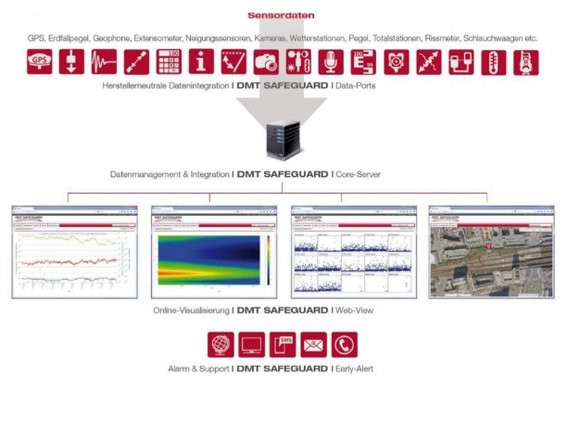
We rely on digital monitoring solutions to ensure transparent and efficient project management. With DMT SAFEGUARD, our professional tool for centralised data storage and monitoring, measurement data can be continuously recorded, analysed and documented.

DMT SAFEGUARD supports the preservation of evidence through a centralised database, transmits alarm messages and enables the remote monitoring and control of ventilation systems. This provides project managers with a transparent basis for responding promptly to changes in the construction process or in measured values.

What You Should Know

Frequently Asked Questions on Tunnel Ventilation and Gas Control

Tunnel ventilation refers to the technical provision of sufficient fresh air to tunnel structures, tunnel boring operations and underground work areas. At the same time, contaminated air, exhaust fumes, dust and, where applicable, gases are removed in a controlled manner. It creates the conditions necessary for safe working conditions, processes that comply with regulations and predictable construction site operations.

During the construction, operation and maintenance of tunnels, diesel exhaust fumes, dust, blasting gases or naturally occurring gases can affect air quality. A ventilation system designed to meet specific requirements reduces these impacts and helps ensure compliance with occupational health and safety regulations. Temperature, air velocity and the distribution of air within the work area are also key factors in achieving an effective solution.

We design ventilation and monitoring systems for, amongst other things:

· Tunnel boring in transport, railway and road construction

· Construction, refurbishment and maintenance work in existing tunnels

· Mines and other underground operational areas

· Wastewater systems and landfill sites

· Projects with specific requirements regarding air quality, dust control and gas monitoring

The sizing is based on the specific conditions of each project. These include, in particular, the length and cross-section of the tunnel, the construction method, the number and capacity of the machines used, the number of workers on site at any one time, potential releases of pollutants, dust generation, and the planned construction and logistics arrangements.

For diesel-powered machinery, engine power is an important design factor. The German Social Accident Insurance (DGUV) specifies an air flow rate of 4 m³ per minute per kW of diesel power used, plus 2 m³ per minute per person employed, as a general guideline. However, the specific design must always take account of the project-specific circumstances.

The assessment depends on the construction method, the machinery used and the geological conditions. Relevant sources of pollution may include, for example:

· Exhaust fumes from diesel-powered vehicles and equipment

· Dust from mining, drilling, blasting or transport processes

· Blasting fumes

· Harmful or flammable gases

· Oxygen-displacing gases

· Emissions from building materials or technical installations

We identify the relevant factors and develop a concept for air supply, extraction, dust removal and monitoring using measurement technology.

Supply air is the fresh air specifically fed into the work area. It provides staff and machinery with sufficient air and dilutes or displaces pollutants.

Exhaust air is the air extracted from the work area. It may contain dust, gases or exhaust fumes and is channelled out of the tunnel area in a controlled manner.

Airflow management describes the planned routing and distribution of these airflows. It ensures that fresh air reaches the relevant work area and that contaminated air does not flow back into other areas.

Fixed ventilation systems are particularly suitable for longer-term construction or operational phases with consistent requirements. Mobile systems offer flexibility when work sites, tunnelling positions or logistical processes change frequently.

In many projects, a combination of both is advisable. During the planning stage, we take into account that site logistics or the movement of machinery can affect the airflow. Where necessary, additional mobile ventilation levels are provided to ensure that ventilation remains effective even when operational procedures change. [1]

A ventilation system may consist of the following components:

· Main and auxiliary fans

· Ventilation pipes or ducts

· Supply air and extract air systems

· Dust detection and removal systems

· Sensors for measuring gases, dust and airflows

· Control, alarm and data transmission technology

· Power supply and redundancy concepts

DMT designs the components to ensure they are compatible with the construction methods, geometry, machinery design and safety requirements of the project.

Air quality is monitored using appropriate measuring equipment, either continuously or at specified intervals. Depending on the risk assessment, parameters such as gas and dust concentrations, oxygen content, air velocity, air flow rate, temperature and pressure may be monitored.

On this basis, operating conditions can be assessed, instances where limit values are exceeded can be detected at an early stage, and alarm or corrective measures can be defined.

DMT SAFEGUARD supports the centralised collection, storage and evaluation of measurement and plant data. The solution enables structured project monitoring and automated analysis of monitoring data. This allows those responsible to track developments, document relevant events and receive defined alarm notifications. [2]

The specific scope of functions is tailored to the technical and organisational requirements of the respective ventilation project.

You might also be interested in these ventilation technology services