A versatile molecule
Immerse yourself in the fascinating world of hydrogen – a key energy source for the future and a cornerstone of the energy transition! On our information page, we offer a comprehensive collection of valuable insights to help you better understand the potential and challenges of hydrogen and its derivatives.
Would you like to find out more about this versatile energy source and its potential applications? Please contact our Hydrogen Team.
On this page you will find a list of frequently asked questions and our answers (FAQs) on the subject of hydrogen. You will also find a number of other resources, such as an overview of funding schemes and links to maps, project overviews, legislation and studies. If you have any further questions that haven’t been answered here, or if you’d like to explore the topic in more depth, please feel free to contact us.
Hydrogen is the lightest and most abundant element in the universe. It is a colourless, odourless gas that can be used as an energy source. Unlike many other chemical substances, hydrogen is non-toxic and does not pose an immediate danger when released into the environment. However, hydrogen can be dangerous in enclosed spaces as it can displace oxygen, leading to a risk of suffocation. In the event of a leak in an enclosed space, there is also a risk of explosion, as hydrogen is highly flammable. Good ventilation and leak detection are therefore crucial to ensuring safety.
Hydrogen has a high gravimetric energy density (33.3 kWh/kg; petrol: 12 kWh/kg), which makes it an efficient energy carrier. Its volumetric energy density (2.8 kWh/m³; petrol: 9,000 kWh/kg), on the other hand, is very low. Consequently, for practical use, it must be compressed, liquefied or chemically bound – which requires significant energy and technical resources. Suitable carrier substances for hydrogen include, for example, ammonia and methanol, which can carry many times more hydrogen than pure hydrogen.
These carrier substances, known as hydrogen derivatives, allow large quantities of energy to be stored and transported, which is particularly advantageous for mobile applications such as vehicles. Furthermore, they also make hydrogen an attractive option for importing clean energy on a large scale from global sources. This allows the location where hydrogen is produced using solar energy (e.g. electrolysis in the Global South) to be organised flexibly, and the location and time of its use to be decoupled from one another.
When combined with oxygen, it burns to form pure water. This essentially produces clean water vapour, thereby helping to prevent climate-damaging emissions from fossil fuels at a local level.
Hydrogen is highly flammable and can form explosive mixtures when combined with oxygen. This property requires special precautions to be taken during storage and handling. However, hydrogen is no more dangerous than other flammable gases such as natural gas or propane when handled under controlled conditions. It is technically very easy to manage and has been used in various industrial sectors for many years.
Hydrogen can help to significantly reduce greenhouse gas emissions as an energy carrier if it is produced from renewable sources, but its production from fossil fuels can still result in CO₂ emissions.
As a molecule itself, it has the following effects:
Fuel cells: Hydrogen is used in fuel cells to generate electricity. This is particularly relevant for transport, which is intended to operate emission-free. However, stationary fuel cells for power generation are also a use case. On the subject of safety: there are often concerns regarding safety, as hydrogen is a highly flammable and volatile gas. Here are a few points that highlight the safety of hydrogen systems:
Direct reduction in the steel sector: Hydrogen can be used as a reducing agent in steel production to replace the use of coal and significantly reduce CO₂ emissions.
Chemical industry: Hydrogen is an important raw material in the chemical industry, where it is used to produce ammonia, methanol and other chemicals.
Power generation: Hydrogen can, for example, be burned in adapted gas turbines or in mixtures with natural gas. This makes it a flexible and low-emission energy source. However: Efficiency losses are high in this process (electricity is converted into → H₂, which is then burnt and (once again) converted into → electricity). Hydrogen is not entirely emission-free as a fuel either. Depending on the process, varying levels of NOₓ emissions can result. For this reason, hydrogen is more suitable as a backup solution or for specific applications, rather than as a permanent solution for energy generation.
Storage of renewable energy: Hydrogen can be used as a storage medium for surplus renewable energy by producing it from water via electrolysis. This energy can later be converted back into electricity when electricity demand cannot be met by renewable sources such as wind and solar PV.
Generation of process heat: In industry, hydrogen can be blended into fuel in burners. This allows hydrogen to be used in energy-intensive sectors until a complete transition to hydrogen is achieved.
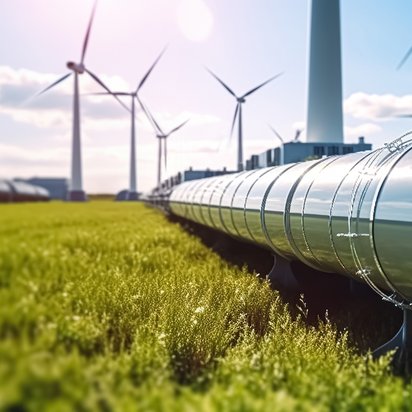
Hydrogen can be produced by the electrolysis of water, the steam reforming of natural gas, or through thermochemical processes. If renewable energy (e.g. wind, solar or hydroelectric power) is used in hydrogen electrolysis, this is referred to as green hydrogen. In most other production processes, it is therefore important to capture and permanently store the resulting CO₂ in order to produce sustainable hydrogen in these cases as well.
The ‘colour’ classification describes the origin of the hydrogen: green hydrogen is produced from renewable energy sources, blue hydrogen from fossil fuels with CO₂ capture, and grey hydrogen from fossil fuels without CO₂ capture. Here is an overview of all the ‘colours’:
Green hydrogen:
Production: Through electrolysis, water (H₂O) is split into hydrogen (H₂) and oxygen (O₂) using electricity from renewable sources such as wind, solar or hydro power.
CO₂ emissions: No direct CO₂ emissions, as the energy sources are renewable.
Blue hydrogen:
Production: From fossil fuels, usually natural gas, via a process known as steam reforming. The CO₂ produced in this process is captured and stored (see Carbon Capture and Storage [CCS]).
CO₂ emissions: CO₂ emissions are reduced because the CO₂ is captured and stored, but not completely eliminated.
Grey hydrogen:
Production: From fossil fuels, usually natural gas, via steam reforming without CO₂ capture.
CO₂ emissions: High CO₂ emissions, as the CO₂ is not captured.
Turquoise hydrogen:
Production: Through methane pyrolysis, in which natural gas is broken down into hydrogen and solid carbon.
CO₂ emissions: No direct CO₂ emissions, as the carbon is present in solid form and is not released as CO₂.
Brown or black hydrogen:
Production: From coal via gasification or other processes. However, this does not take place on an industrial scale.
CO₂ emissions: Very high CO₂ emissions, as coal is a carbon-rich fuel and no CO₂ capture takes place.
Red hydrogen
Production: Hydrogen is produced via thermochemical processes using nuclear energy. Heat from nuclear reactors is used to split water into hydrogen and oxygen.
CO₂ emissions: The production of red hydrogen is virtually CO₂-free, as the energy source – nuclear power – does not cause any direct CO₂ emissions. However, there are environmental concerns regarding the disposal of radioactive waste and the safety of nuclear power stations.
White hydrogen:
Production: White hydrogen refers to naturally occurring hydrogen that exists in geological formations without human intervention. It is therefore not produced through industrial processes. White hydrogen is a promising energy carrier due to its potentially CO₂-free extraction. Despite its potential, the commercial use and widespread adoption of white hydrogen are currently limited. This is mainly due to the difficulty of extraction, a lack of infrastructure, limited research and development, and regulatory and economic challenges.
CO₂ emissions: As white hydrogen occurs naturally and is not produced by industrial processes, no direct CO₂ emissions are associated with its extraction. The challenge lies in the (cost-effective) extraction and utilisation of these natural deposits.
Hydrogen derivatives are chemical compounds produced from hydrogen or containing hydrogen as an essential component. These derivatives are often used to store, transport or utilise hydrogen in various industrial processes, as they carry greater quantities of hydrogen per unit volume than pure hydrogen itself. Among the most common derivatives are ammonia and methanol, which are used as carriers for hydrogen or as raw materials in the chemical industry.
Fuel cells, hydrogen internal combustion engines (with significantly reduced emissions compared with those running on fossil fuels) and hydrogen turbines are some of the technologies that can be used to utilise hydrogen as an energy carrier. In green steel production, it is used as a CO₂-free fuel in place of coal or coke. It is also used in the production of ammonia (e.g. in the fertiliser industry), methanol (for use as a fuel or in the chemical industry) or as a coolant.
The key players include energy companies, technology developers, governments, investors, operators and end users from various sectors. The value chain in the H₂ market essentially comprises energy generation (for hydrogen production), hydrogen production, storage, transport and application.
Hydrogen is regarded as a key component of the energy transition, as it can contribute to the decarbonisation of industry and transport and support the integration of renewable energy.
Green hydrogen is currently generally more expensive than grey or blue hydrogen, as the production costs for renewable energy are higher. There are no reliable price figures available for the other types, as the technologies are still under development, are not yet widely used, or have not yet been commercially developed at all.
Hydrogen must be able to compete with fossil fuels on price, which requires a reduction in production costs through technological advances and economies of scale. The price of hydrogen can vary considerably today, depending on the production method and market conditions. Generally speaking, the price of hydrogen in Germany has ranged in recent years from 5–6 euros in the industrial sector to 8–15 euros per kilogramme at HRS (Hydrogen Refuelling Stations), with green hydrogen tending to be more expensive than grey or blue hydrogen. To be competitive, particularly compared with fossil fuels, the aim is to reduce the cost of green hydrogen to around 2 to 3 euros per kilogramme (6 euros at refuelling stations). This requires technological advances and economies of scale in production and infrastructure, which must be further bolstered by incentives for manufacturers and users.
Furthermore, funding schemes should be reactivated and relaunched to make investment in hydrogen more attractive. Furthermore, green electricity must become cheaper, as the price of electricity is the most significant cost factor in electrolysis. This will ensure that the necessary infrastructure can be built in time for the ramp-up, enabling hydrogen to outcompete fossil fuels – which have inevitably become more expensive due to CO₂ allowances.
Investing in hydrogen is worthwhile, as the technology is mature and demand is rising. Looking ahead, investments in hydrogen make sense, as it is set to become an integral part of the future energy landscape (worldwide). Areas of interest include production, storage, transport and applications in industry and the transport sector.
Hydrogen is a highly volatile and highly flammable substance and requires specialised tanks and infrastructure for safe transport and storage, which entails additional costs and technical challenges.
Sector coupling refers to the integration and interconnection of different energy sectors – such as electricity, heating and transport – in order to increase efficiency and maximise the use of renewable energy. Through sector coupling, hydrogen is used as an energy carrier to store surplus renewable energy and utilise it in other sectors when required. This enables a flexible and sustainable energy supply by breaking down the barriers between sectors and promoting a holistic approach to energy use. Hydrogen plays a central role in sector coupling, as it acts as a link between electricity generation, industrial use and mobility.
Germany plays a leading role in the hydrogen market, both in terms of technological development and the policy framework:
If, after reading this list of FAQs, you still have any questions that remain unanswered here, or if you would like to explore the topic in greater depth, please do not hesitate to contact us. Contact: wasserstoff@hydrohub.de or contact Manuel Frinke (frinke@energy-engineers.de) or Friederike Ferdinand (ferdinand@energy-engineers.de) directly

Discover the wide range of funding opportunities available to you for implementing your hydrogen projects – at both German and European level. Our funding overview will help you find the right funding sources for your project and make the most of them to turn your visions into reality.
Please feel free to contact our funding expert, Wiebke Wronna, for a no-obligation discussion.
Be inspired by successful hydrogen projects that are already underway. Find out more about innovative approaches and best practices that can offer you valuable insights and ideas for your own projects. In our constantly updated overview, we show you where H2 projects are taking shape. You’re sure to find points of connection. We’ll support you in successfully implementing your project.
General information pages:
Project landscape:
Expand your knowledge with a selection of studies and documents on hydrogen. These resources provide you with in-depth information and the latest insights to help you better understand developments in the hydrogen sector and make strategic use of them.