Zum Inhalt springen

Do you know the science that studies caves? Learn about speleology

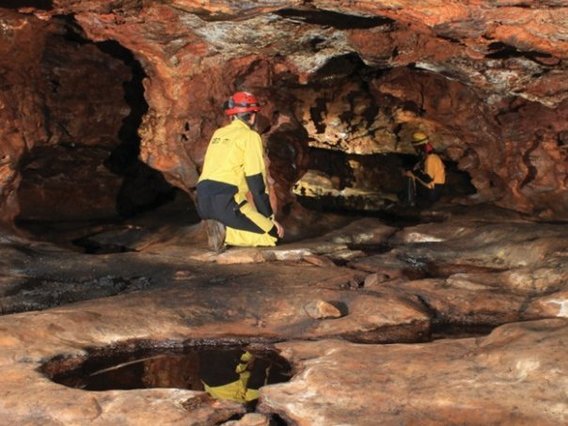
Simmons Cave, located in the municipality of Barão de Cocais, in the state of Minas Gerais. A cave named in honor of the American geologist George Simmons. Source: ZAMPAULO, R. A. In: SIMÕES, M. H.; ZAMPAULO, R. A.; BRANDI, I. V. (Eds.). Guide to Best Practices for the Speleological Monitoring of Iron-Bearing Caves. Vale, p. 36.

The term “speleology” derives from the Greek words *spélaion* (cave) and *logos* (study, science), and thus refers to the study of caves. It is an interdisciplinary science dedicated to the investigation of natural underground cavities, covering aspects of their formation, morphology, hydrology, geology, biology, and climatology, as well as their historical, cultural, and environmental relationship with humans. In addition to its scientific nature, speleology also plays a fundamental role in the conservation of speleological heritage, environmental management, and the sustainable use of caves for educational, tourist, and cultural purposes.

•Cave: What Is It?

A cave is, by legal definition (Federal Decree No. 10,935/2022), an underground space accessible to humans—with or without an identifiable opening—formed by natural processes. This definition encompasses the cave’s environment, its mineral and water content, and its flora and fauna. In addition to the legal definition, the International Union of Speleology defines a cave as a “natural opening formed in rock below the ground surface, wide enough for a person to enter.”

It is worth noting that, under the law, the terms “cave,” “grotto,” “lapa,” “den,” “abyss,” “furna,” and “hole” are all synonyms.

•The Formation of Caves

Caves can be classified as primary or secondary, depending on their origin in relation to the rock. Primary caves form at the same time as the rock, such as voids in limestone tuffs or lava tubes created by the differential cooling of magma. Secondary caves, on the other hand, form after the rock has been formed, through mechanical processes (tectonic fractures and marine erosion, common in igneous rocks) and physicochemical processes, with the latter—erosion and dissolution—being responsible for the majority of the world’s caves.
Caves in carbonate rocks—the most common type in Brazil—are predominantly associated with chemical dissolution processes characteristic of karst environments. These caves form when rainwater, enriched with carbon dioxide as it passes through the atmosphere and soil, becomes slightly acidic and begins to dissolve carbonate minerals. Initially, the process is diffuse and underground, slowly enlarging small passages, which over time evolve into galleries, chambers, and complex cave systems.

Figura: Infográfico "A Gênese de uma Caverna" . Fonte: Elaborado pelo autor (2026), com ilustrações geradas por Inteligência Artificial.

•Potential Areas for Cave Formation

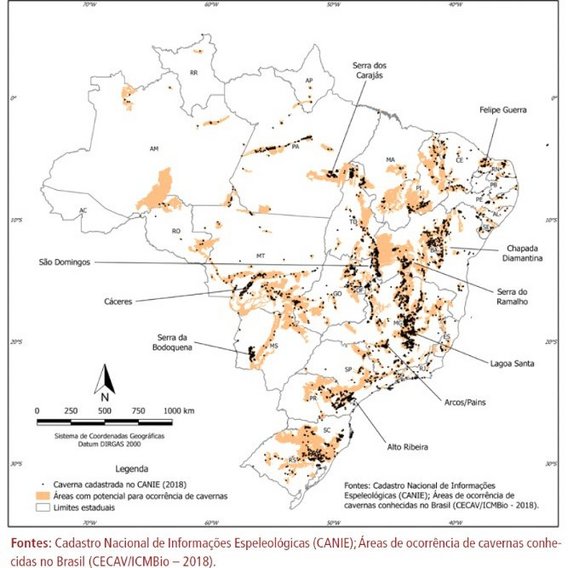
About 90% of the world’s caves form in carbonate rocks, primarily limestone and dolomite. Brazil, due to its humid and subhumid tropical climate and the extensive area where these rocks occur (about 190,000 km²), has great speleological potential. In addition to carbonate rocks, sandstones and quartzites are also conducive to cave formation, as are iron-bearing formations and canga, which have recently been recognized as important. To a lesser extent, caves occur in granite, gneiss, other metamorphic rocks, and even in soil cover.

The Chico Mendes Institute for Biodiversity Conservation (ICMBio) has released a map of Brazil showing the potential for cave occurrence. This map can be viewed here.

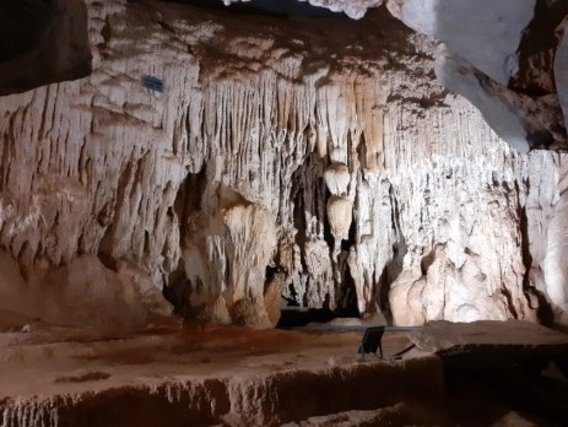
Figura: Interior da Gruta da Lapinha, destacando as formações de espeleotemas, localizada no Parque Estadual do Sumidouro, Lagoa Santa - MG. Fonte: MAPA CULTURAL LAGOA SANTA. Disponível em: https://parqueestadualdosumidouro.com.br. Acesso em: 11 jun. 2026.

• Environmental Protection


As noted earlier, carbonate rocks and iron-bearing formations have a high potential for cave formation. These areas, in addition to being of great economic interest—particularly for mining—also hold significant environmental value.

To this end, certain legal and sub-legal regulations have been established to protect the natural heritage represented by these caves and to promote sustainable development.

Federal Decree No. 10,935/2022 is the primary regulatory framework in effect today. This decree provides for the protection of caves within Brazilian territory and classifies them into four levels of significance—maximum, high, medium, or low—based on ecological, biological, geological, hydrological, paleontological, scenic, historical-cultural, and socioeconomic attributes, analyzed at the local and regional levels.

Caves of maximum significance are those that exhibit at least one attribute considered exceptional (such as endemic or rare species, unique paleontological records, high biological diversity, among other technical criteria defined in complementary regulations).

For authorized impacts, the developer must adopt compensatory measures, which may include the preservation of other caves or actions aimed at conserving speleological heritage.

This decree, however, raises a point of concern: previously, under Federal Decrees No. 99,556/1990 and No. 6,640/2008, a cave classified as being of the highest importance could not be subject to irreversible negative impact. Under the 2022 decree, these caves could be subject to irreversible negative impacts if the developer demonstrated that the activity was in the public interest, that there were no technical or locational alternatives, that the compensatory measure was feasible, and that the impacts would not lead to the extinction of any species inhabiting the cave. However, Article 4, along with its subparagraphs I, II, III, and IV, and Article 6—which authorized this possibility of impact and permitted activities or projects in areas of influence, respectively—are currently under review by the Federal Supreme Court (ADPF 935) for possible violation of a fundamental principle and a regression in environmental protection. While under review, these articles will be suspended, thereby giving effect to Article 3 of Decree 99.556/1990, as amended by Decree 6.640/2008.

CONAMA Resolution No. 347/2004 establishes guidelines for the protection of natural underground cavities within the context of environmental permitting, stipulating that any project or activity with the potential to cause an impact must take into account the existence of caves and their area of influence, particularly with regard to the preservation of their physical, biological, and hydrological conditions. The regulation reinforces the need for preliminary speleological studies, stipulates that negative impacts on caves of significant importance must be avoided, and makes authorization for intervention contingent upon an assessment by the competent environmental agencies, thereby integrating the protection of speleological heritage into the country’s environmental licensing and monitoring procedures.

ICMBio, the agency responsible for protecting cave and speleological heritage, has drafted several Normative Instructions (IN) that establish procedures for proposing compensation measures (ICMBio IN No. 01/2017) and for classifying the degree of significance of caves (ICMBio IN No. 02/2017), among others that can be consulted here.


⦁Case Study: Lapinha Cave (Lagoa Santa – MG) and the Limestone Mining Companies

One of the most emblematic examples of the tension—and the possible balance—between caving and mining can be found in the Belo Horizonte metropolitan area. The Lapinha Cave, located in Sumidouro State Park (Lagoa Santa, Minas Gerais), is one of Brazil’s most visited and best-equipped tourist caves, featuring scenic lighting, walkways, and a rich diversity of calcite speleothems. What many visitors fail to realize as they admire these formations is that the region of Lagoa Santa, Pedro Leopoldo, and Matozinhos is also home to one of the country’s largest lime and cement production hubs.

This proximity is no coincidence: the entire region rests on an extensive carbonate formation—the same geological substrate that gave rise to the cave systems and that also feeds the open-pit mining operations just a few kilometers from the park. For these mining activities to continue operating legally, companies in the sector must comply with strict environmental requirements established in the environmental licensing process based on the regulations described throughout this blog, such as Federal Decree No. 10,935/2022 and CONAMA Resolution No. 347/2004.The main challenge in this scenario is to ensure that the vibrations caused by blasting and the operation of heavy equipment do not cause microcracks in the illuminated chambers of Lapinha or compromise the physical integrity of its fragile speleothems. To this end, seismic monitoring is conducted continuously: seismographic instruments record and analyze vibration waves, ensuring that levels remain within permitted technical limits. This monitoring is both a requirement of environmental licensing and a concrete demonstration that speleological science plays an active role in protecting caves even within industrial environments.

The successful coexistence of mining operations and caves is a direct result of planning, continuous monitoring, and strict compliance with legal requirements. Measures such as classification by degree of significance and the implementation of compensatory measures thus become indispensable tools that allow society to extract essential mineral resources while safeguarding an irreplaceable geological, biological, and cultural heritage.
• References

BRASIL. Conselho Nacional do Meio Ambiente (CONAMA). Resolução nº 347, de 10 de setembro de 2004. Dispõe sobre a proteção das cavidades naturais subterrâneas existentes no território nacional. Diário Oficial da União, Brasília, DF, 13 set. 2004. Disponível em: <https://www.siam.mg.gov.br/sla/download.pdf?idNorma=217>. Acesso em: 31 mar. 2026.

BRASIL. Decreto nº 10.935, de 12 de janeiro de 2022. Dispõe sobre a proteção das cavidades naturais subterrâneas existentes no território nacional. Diário Oficial da União, Brasília, DF, 12 jan. 2022. Disponível em: <https://www.planalto.gov.br/ccivil_03/_ato2019-2022/2022/decreto/d10935.htm>. Acesso em: 31 mar. 2026.

BRASIL. Decreto nº 99.556, de 1º de outubro de 1990. Dispõe sobre a proteção das cavidades naturais subterrâneas existentes no território nacional. Diário Oficial da União, Brasília, DF, 2 out. 1990. Disponível em: <https://www.planalto.gov.br/ccivil_03/decreto/1990-1994/D99556.htm>. Acesso em: 31 mar. 2026.

 BRASIL. Decreto nº 6.640, de 7 de novembro de 2008. Dá nova redação ao Decreto nº 99.556, de 1º de outubro de 1990, que dispõe sobre a proteção das cavidades naturais subterrâneas. Diário Oficial da União, Brasília, DF, 10 nov. 2008. Disponível em: <https://www.planalto.gov.br/ccivil_03/_ato2007-2010/2008/decreto/d6640.htm>. Acesso em: 31 mar. 2026.

 BRASIL. Ministério do Meio Ambiente. Instrução Normativa nº 1, de 30 de agosto de 2017. Define procedimentos administrativos relativos às cavidades naturais subterrâneas no âmbito do licenciamento ambiental federal. Brasília, DF: MMA, 2017. Disponível em: <https://www.gov.br/icmbio/pt-br/acesso-a-informacao/institucional/legislacao/instrucoes-normativas/arquivos/intrucao_normativa_01_2017.pdf>. Acesso em: 31 mar. 2026.

 BRASIL. Ministério do Meio Ambiente. Instrução Normativa nº 2, de 30 de agosto de 2017. Define a metodologia para a classificação do grau de relevância das cavidades naturais subterrâneas. Brasília, DF: MMA, 2017. Disponível em: <https://www.gov.br/icmbio/pt-br/assuntos/centros-de-pesquisa/cavernas/orientacoes-e-procedimentos/legislacao-espeleologica/in-02_2017_mma_30ago17.pdf>. Acesso em: 31 mar. 2026.

BRASIL. Instituto Chico Mendes de Conservação da Biodiversidade (ICMBio). Potencialidades de ocorrência de cavernas no Brasil. Brasília, DF: ICMBio, [s.d.]. Disponível em: <https://www.gov.br/icmbio/pt-br/assuntos/centros-de-pesquisa/cavernas/publicacoes/Potencialidades%20de%20Ocorrencias%20de%20cavernas>. Acesso em: 31 mar. 2026.

FERNANDES, Antoniel Silva; FARIA, Luciano Emerich (org.). Gruta do Maquiné: 190 anos: um ícone do patrimônio espeleológico brasileiro. Belo Horizonte: Rupestre, 2024.ICMBio. Instituto Chico Mendes de Conservação da Biodiversidade. Espeleologia e Licenciamento Ambiental / Jocy Brandão Cruz e Luís Beethoven Piló. [org] – Brasília: ICMBio, 2019. 262 p.